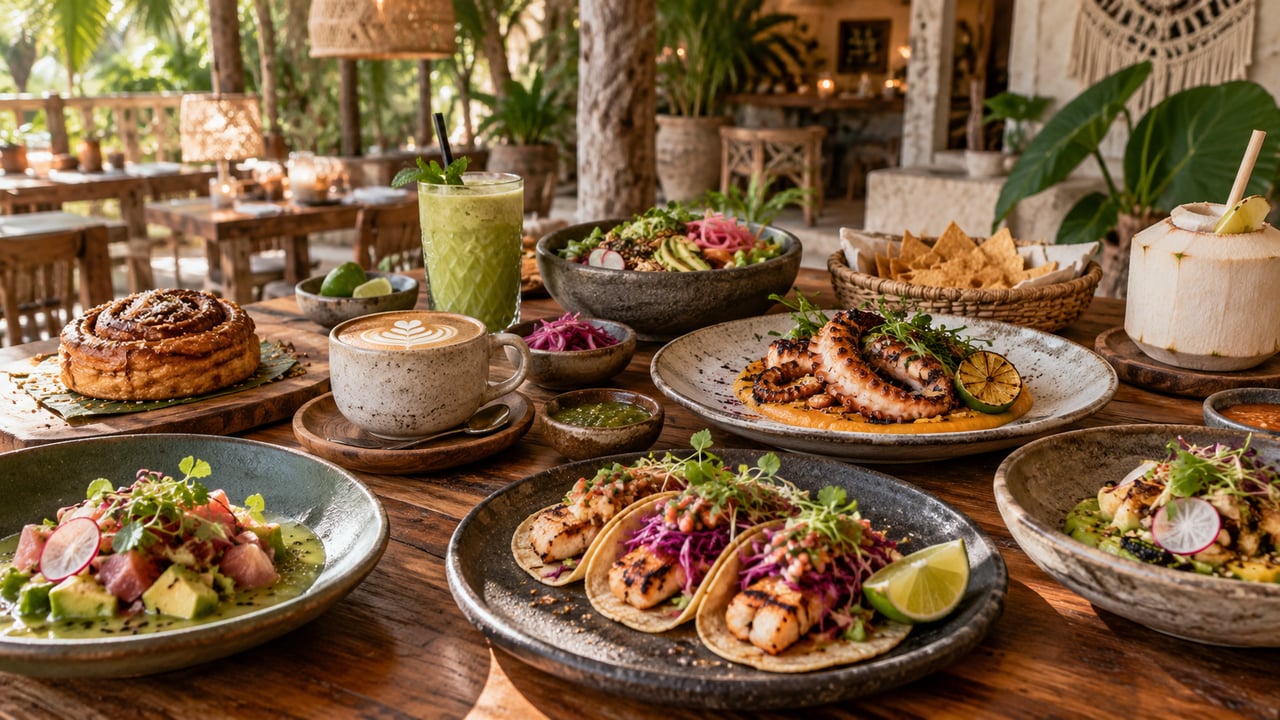
Drive the Tulum-Boca Paila road on a September evening and you will pass Rosa Negra with its resident DJ working the crowd and a chile en nogada special drawing a full terrace, then roll another few hundred meters south and find Taboo, run by the same parent company, with its kitchen dark after 7pm. Both sit near kilometer 7. Both belong to Grupo Rosa Negra. One is serving a full dinner service built around a seasonal dish. The other has suspended dinner entirely until sometime between November and December.
That split is the story this September, more than any single closure or opening. Low season on the beach road used to mean a shared, predictable slowdown: a few weeks of reduced staff, maybe a paint job, everyone back on schedule by the time the first snowbirds land. This year the road doesn't move together. It moves kitchen by kitchen, and the reason has less to do with tourism trends in general and more to do with what each specific property is spending to keep its stretch of sand clear.
If you live along this road, or you're weighing a property that puts you within walking distance of it, the practical question isn't "is the Hotel Zone quiet right now." It obviously is. The question is which of the names you already know are actually running a kitchen tonight, and that answer has stopped following a calendar.
The Numbers Behind the Empty Tables
Hotel occupancy in Tulum dropped to roughly 41.5 percent in early September 2026, down from levels the Riviera Maya has not seen in a decade, according to state tourism data reported by Yucatán Magazine. Some hotels along the coastal strip were running as low as 15 to 20 percent, with all-inclusive properties holding closer to 40 percent, a gap that matters because those two categories carry very different fixed costs.
The Asociación de Hoteles de Tulum has pointed to a specific line item behind the slump: sargassum cleanup. For some properties, clearing seaweed from a private stretch of beach now runs upward of 500,000 pesos a week, a cost that exists whether the rooms behind that beach are full or empty. The association has compared the daily collection bill to what a property pays for electricity, which is a useful way to think about it. You don't turn off the power because occupancy is soft. You still pay it. Beach cleanup has become that kind of cost, and it lands on restaurants and beach clubs the same way it lands on hotels, since most of the dining on this strip sits inside or beside a hotel property.
Put those two numbers together, occupancy near 40 percent and cleanup costs that don't scale down with demand, and you get a margin squeeze specific to properties that depend on beachfront foot traffic. A restaurant that can shift to a shorter, lower-staff dinner window, or drop it altogether for a few months, will do exactly that if the arithmetic says so. A restaurant that isn't as exposed to that specific cost, or that has other business reasons to stay open, won't. That's the mechanism behind the split you see driving the road tonight.
One Owner, Two Calendars
Taboo's current low-season hours run 11am to 7pm, with dinner service after 7pm temporarily suspended and no confirmed reopening date beyond a window of November to December 2026. Taboo Beach Club continues to operate during the day as a separate business line, so the daytime crowd hasn't gone anywhere. It's specifically the evening restaurant service that's paused.
Rosa Negra, under the same ownership group and a short distance up the road, is doing the opposite. This August and September the restaurant has built a seasonal menu moment around chile en nogada, the traditional dish tied to Mexican Independence celebrations, served in what the group describes as its most chic stretch of the Hotel Zone. Same company, same low season, two different bets on what the road can support right now.
That contrast tells you something the aggregate occupancy number can't. A group with more than one property on this strip can afford to concentrate its dinner traffic into the location doing the better business and quiet the other one for a season, rather than running both at partial capacity. Independent kitchens don't have that option. They either make the number work at their one address or they don't.
What's Actually Running This Month
Here's a working snapshot of the beach road as of late September, built from each restaurant's own published hours and location. Hours in Tulum change without much notice, so treat this as a starting point for a same-day check, not a guarantee.
| Restaurant | Location | Current status |
|---|---|---|
| Taboo Restaurant | Km 7 | Dinner suspended after 7pm; daytime beach club open |
| Rosa Negra | Near Km 7 | Full service, seasonal chile en nogada through September |
| Hartwood | Km 7.6 | Closed Mon and Tue; open Wed-Sun 5:30-10pm |
| Arca | Km 7.6 | Open nightly, roughly 5-11pm |
| NÜ Tulum | Km 8.7 | Operating, farm-to-table menu under chef Luis Aguilar |
| Casa Maria (Diamante K) | Km 5 | Restaurant 8am-10pm; beach club closes 5pm |
| Mezzanine | North strip | Operating, natural-area access hours 8am-5pm outside reservation |
The Kitchens Not Slowing Down
Arca, ranked among the World's 50 Best Restaurants in 2025 and run by chef José Luis Hinostroza, has kept a full nightly schedule through the slow months. Hartwood, the restaurant that arguably built this stretch of road's reputation for open-fire, jungle-side dining back in 2010, is holding its usual rhythm too, closed Monday and Tuesday as it typically has been, open the rest of the week. Neither has signaled a seasonal pullback the way Taboo has.
NÜ Tulum, tucked at kilometer 8.7 and known for its zero-waste, farm-to-table approach under chef Luis Aguilar, continues its candlelit service sourced in part through a partnership with a regenerative farm on the Yucatan Peninsula. Mezzanine, the Thai restaurant that has anchored the north end of the strip for roughly twenty years, is still running its bottomless brunch and full menu, though its location inside a protected natural area means general access hours of 8am to 5pm apply unless you have a dinner reservation.
None of these are large all-inclusive operations insulated from the occupancy drop. They're independent, chef-driven kitchens making a different calculation than Taboo's parent company made for that one property. Some of that comes down to reputation and reservation demand strong enough to absorb a quiet September. Some of it comes down to a beach frontage that costs less to maintain, or a business model less dependent on it.
Why the Old Rule of Thumb Doesn't Hold This Year
The assumption residents have relied on in past years, that everything reopens by November regardless of how quiet September and October get, was built on a low season that behaved the same way every year. This one has a specific, unusual driver stacked on top of the normal seasonal dip. Cancún International saw roughly 274,000 fewer passengers in June 2026 compared to the year before, a drop tied partly to airline route cuts and partly to sargassum's effect on the region's reputation. Layer that onto cleanup costs that keep rising regardless of demand, and you get hoteliers along the coastal strip who have told regional business press they are exploring loan restructuring just to get through the stretch. When the financial pressure is this specific and this uneven across properties, the reopening dates stop being predictable. They become a decision each operator makes on their own timeline.
What to Check Before You Drive Down the Road
A few habits make more sense this particular season than they did last year:
- Call or message the restaurant directly the same day. A posted hours page from even a month ago may already be out of date.
- Note whether the beach club and the restaurant at the same address are run as separate entities, as Taboo's are. One half of the business can be open while the other isn't.
- If a group owns more than one property nearby, as Grupo Rosa Negra does with Taboo and Rosa Negra, expect the group to concentrate its open hours in whichever location is drawing better traffic that month.
- Reservation-forward kitchens with strong reputations, like Arca and Hartwood, have generally kept their normal schedules through the slow months. Newer or less established spots are more likely to have trimmed hours.
The beach road hasn't gone quiet in any uniform sense this September. It has gone uneven, kitchen by kitchen, in a way that reflects each property's own numbers rather than a shared seasonal script. For residents, that means the reliable move isn't remembering which restaurants are open in the off-season. It's checking the specific one you're driving toward, tonight, before you go.
If you're weighing what that kind of block-by-block variation means for a property along this stretch of coastline, from rental income to day-to-day livability, the advisors at Engel & Völkers Tulum know this road well enough to walk it with you.