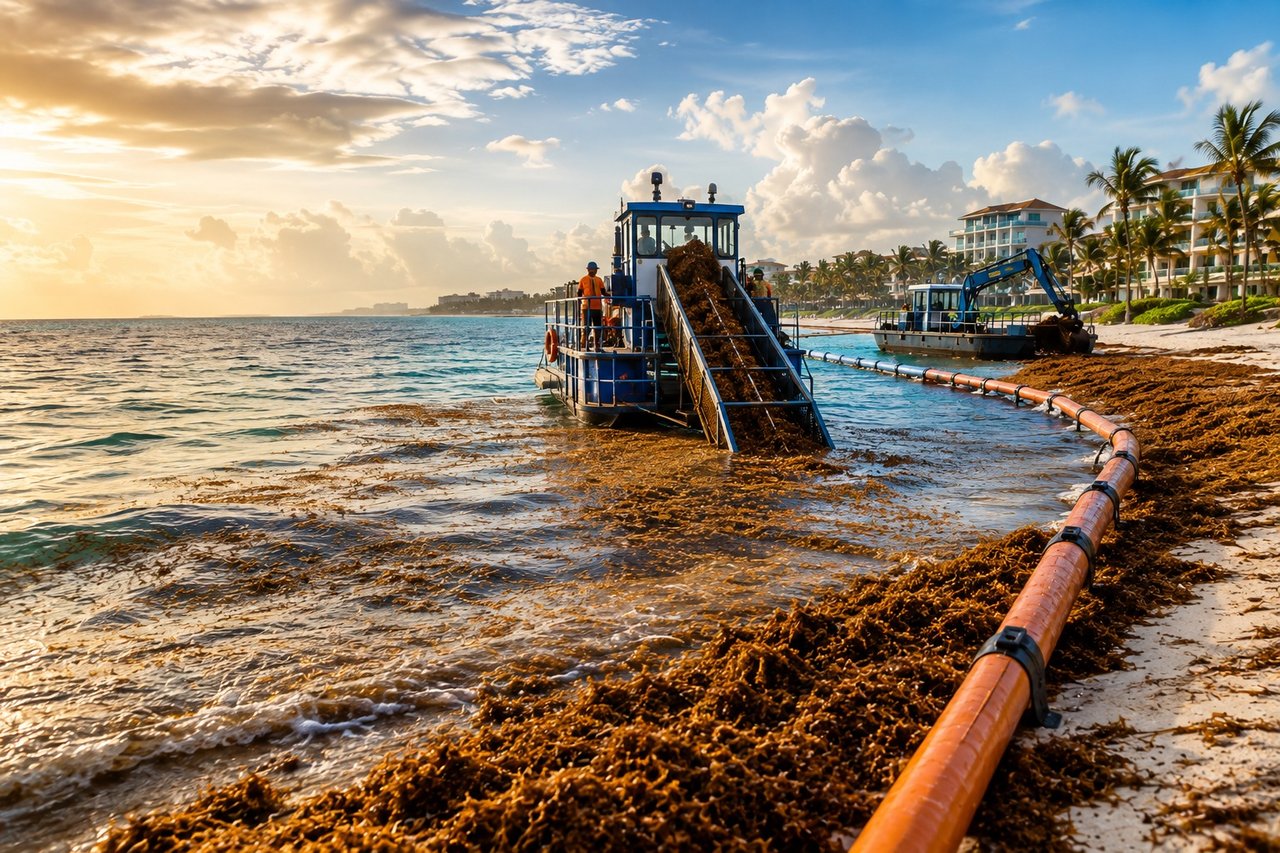
Every summer the same images circulate: golden Caribbean sand buried under brown, rotting seaweed, the smell strong enough to keep tourists off the beach and out of the hotels that depend on them. This year has been the worst on record. Daily sargassum volumes drifting through Mexican Caribbean waters have reached as high as 90,538 tons, with peak daily arrivals on the coast hitting over 9,000 tons, roughly four times last year's levels and 27 times the historical average.
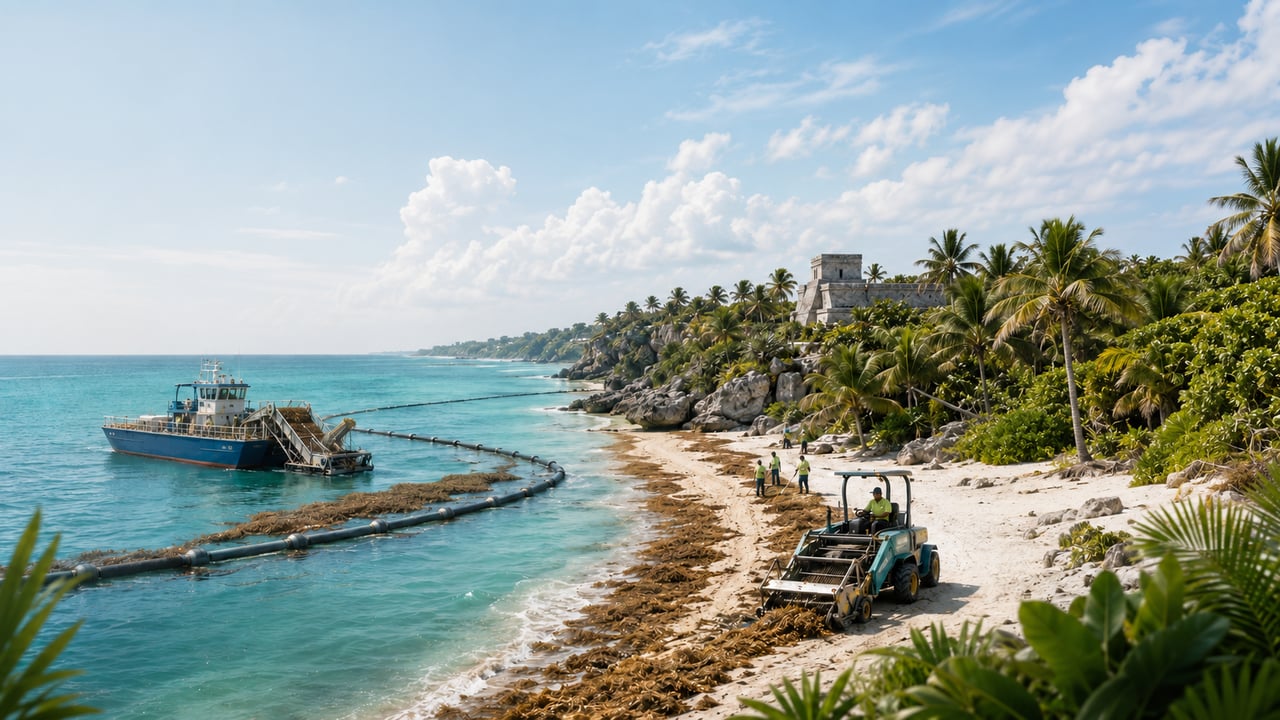
In late July, the Sheinbaum administration responded with a headline number: over 2.6 billion pesos, about $152 million, committed through 2027 to a reinforced Sargassum Action Plan covering the five hardest-hit tourist corridors, Cancún, Playa del Carmen, Puerto Morelos, Tulum, and Mahahual. The initial figure floated at the press conference was 2 billion pesos; it was revised upward within days. Either way, the money buys more collection vessels, tugboats, offshore barriers, and monitoring equipment.
That's the part everyone is covering. It's the wrong part to focus on.
The Cleanup Trap
Two billion pesos, or 2.6 billion, sounds substantial until you compare it to what sargassum already costs the region every year. Quintana Roo's state government has put the annual cost of managing the problem, cleanup crews, lost tourism revenue, hotel operating costs, at around $2 billion USD, roughly 11% of the state's GDP. A one-time federal injection in the low hundreds of millions doesn't come close to covering that, and it isn't meant to. It's meant to buy hardware for a single, unusually bad season.
This is the trap: if sargassum stays classified as waste, something to be scooped off beaches, hauled to landfills, and left to rot in the jungle, then the state is signed up for a recurring, worsening expense with no end date. Every bad season means another emergency budget line. Every budget line becomes a political argument the next time treasury is tight or priorities shift. A strategy built entirely on public cleanup spending is a strategy that runs out of money and patience at the same time.
The Real Strategy: Make the Algae Worth Fighting Over
The more interesting part of what's happening in Quintana Roo isn't the boats and barriers, it's the quiet build-out of a market for sargassum as a raw material.
Mexico's environment ministry, SEMARNAT, has identified 198 sargassum-related initiatives nationally, of which 39 companies are already turning the algae into commercial products: biofertilizers, bioplastics, sodium alginate, plastic lumber, biochar, cosmetic ingredients, even construction material. Eleven of those initiatives are considered ready for industrial-scale expansion. The government has designated a nearly 40-hectare Development Pole for Circular Economy in Puerto Morelos, built around a tax-incentive decree, with the US biomaterials firm Carbonwave named as the anchor tenant. Carbonwave is already exporting sargassum-based fertilizer and pursuing approval to sell domestically, alongside work on cosmetics, textiles, and vegan leather.
Separately, a hotel- and restaurant-led initiative called Caribe Circular is trying to build the demand side of that market from the ground up: hotels harvest and pre-dry sargassum, sell it into the supply chain, then buy back finished products, plates, packaging, biofertilizer, at prices comparable to conventional alternatives. Their 2026 target is modest, around 150,000 tons processed and 250 direct jobs, but the 2028 ambition is real: 80% of Quintana Roo hotels participating, up to 2 million tons processed annually, and thousands of jobs in a sector that didn't exist fifteen years ago.
This is the mechanism that actually solves the problem, not the boats. Once a company can make money buying, drying, and processing sargassum, it doesn't need a government contract to go collect it. It goes and collects it because someone will pay for the output. At that point the incentive structure flips: instead of the state paying to remove a nuisance, private capital competes for a free input. That's the difference between subsidizing a cleanup and seeding an industry.
Where This Could Still Fail
To be fair to the skeptics, this isn't a guaranteed win, and a few things could keep the industrial model from scaling fast enough to matter:
- Volume mismatch. Current collection capacity across government and private actors sits around 2,177 tons a day. Peak drift volumes are over 40 times that. Even a thriving downstream industry needs a harvesting bottleneck solved first, and open-water collection at scale is capital-intensive and technically hard.
- Regulatory drag. Sargassum absorbs heavy metals and microplastics from the water. Products derived from it, especially anything touching food, agriculture, or cosmetics, need to clear safety approvals before they can be sold at scale. That's slower than building a barrier.
- Price competitiveness. Caribe Circular's own model depends on sargassum-based products costing about the same as conventional alternatives. If they cost more, adoption stalls regardless of how much capacity exists.
None of these are fatal, but they're the reason "the problem solves itself" is a thesis, not a certainty. It only holds if the industrial side scales faster than the public cleanup budget shrinks.
The Real Test
Mexico is doing something worth watching closely: treating an ecological nuisance as a feedstock rather than a liability, and using a relatively small public investment to seed the infrastructure, the industrial park, the tax incentives, the anchor tenant, that lets private capital take over from there. If that flywheel spins up, Quintana Roo turns a standing $2 billion annual cost into a resource that companies pay to access. If it doesn't, the current 2.6 billion peso commitment will look, in a few years, like the first of many increasingly hard-to-justify emergency allocations.
The number to watch isn't the size of the next federal pledge. It's how many of those 39 companies are still standing, and growing, without one.