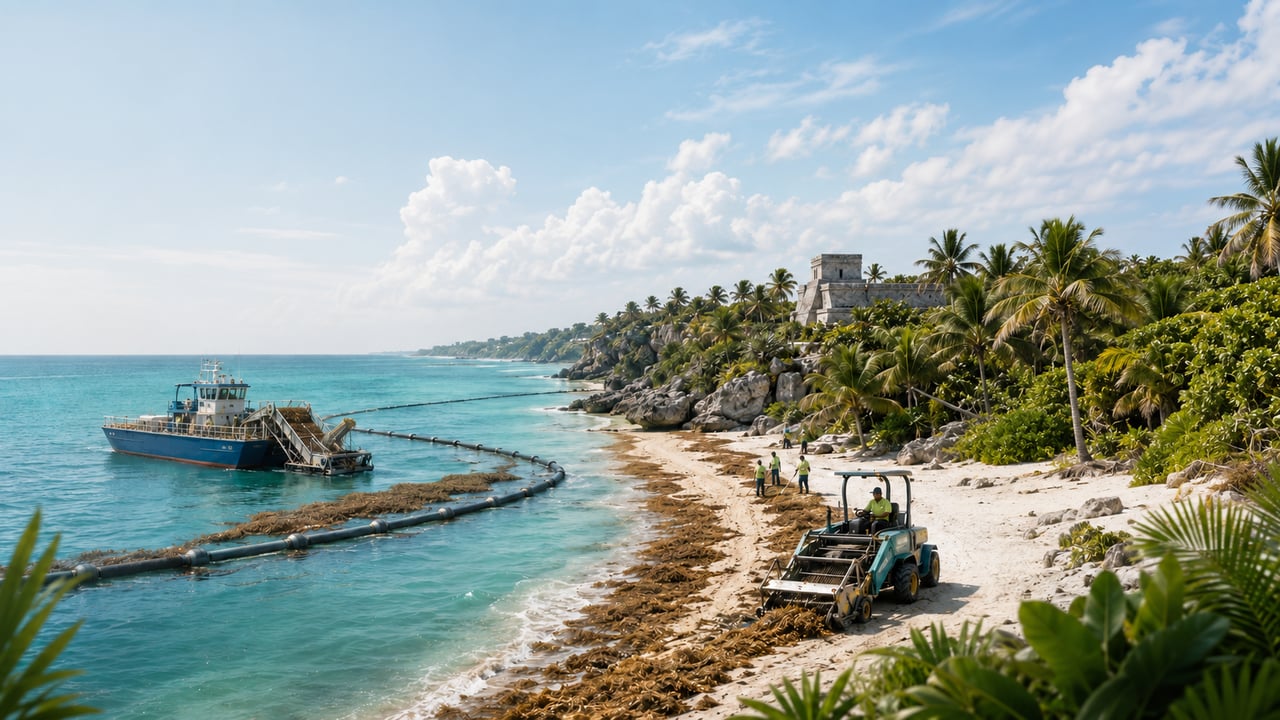
If you live along the Tulum-Boca Paila road, the coastline you knew a year ago is not the coastline you have now. The Renace plan that President Sheinbaum confirmed on her July 2026 visit to Quintana Roo did more than lower a few fees. It quietly redrew the everyday geography of the Hotel Zone into two parallel systems that now sit inches apart on the sand.
One is a public spine of free entrances, most of them created or reopened between last autumn and this July. The other is the familiar private strip, where beach clubs and hotels still control their own frontage and, in some cases, still charge on days the federal mandate says they should not. Understanding which is which has become a resident skill.
The practical question is no longer "can I get to the beach without paying." It is "which of the ten free access points is worth the walk on a Saturday morning, and which is a formality that still ends at a wristband."
The Two Systems, Side By Side
| Public spine | Private strip | |
|---|---|---|
| Access points | 10 free entries along the Hotel Zone and inside Parque del Jaguar | Beach clubs and hotels, some of which signed the mayor's free-access accord |
| Cost | No entry fee, no minimum spend | Officially free where an agreement exists; in practice, admission fees and vehicle restrictions still reported |
| Hours | Roughly 06:00 to 18:00 inside the park | Club hours; typically 11:00 onward |
| Transport | 20-peso electric shuttle operated by Grupo Maya | Private valet, taxi, or your own vehicle |
| Legal basis | July 2026 federal decree, effective July 20 | Voluntary agreement between 15 operators and the municipality |
The two columns are the story. Everything else in this post is texture.
The Two Kilometer Markers That Rewrote the Middle of the Road
For years, the middle stretch of the Tulum-Boca Paila road had no honest public entry. You either knew someone at a club, spent the minimum, or walked from the archaeological zone. That gap is what the two new access points close.
Playa Conchitas sits at kilometer 4.5 of the coastal road, and Playa del Pueblo sits at kilometer 5.5, both inside the Hotel Zone rather than deep in the park. Federal officials described these entrances as historic for a strip previously dominated by private clubs and mandatory consumption requirements, and both are free and open to nationals, foreign visitors, and residents alike, with no payment required at any time.
The distance is what matters here. If you live in Aldea Zama or off Coba, km 4.5 is the first honest public entry you hit heading south. Before this summer, the nearest reliable free access was the traditional gate near the ruins, a full drive further north. The new markers turn a twenty-minute committed outing into a fifteen-minute one, and that changes how often residents actually go.
Inside the Traditional Gate: Four Beaches on a 20-Peso Shuttle
The other half of the public spine sits inside Parque del Jaguar itself. Under the new framework, two main entrances to the park, the traditional access long demanded by locals and a new southern access, now lead to four public beaches: Santa Fe, Pescadores, Maya, and Mangle. A separate account puts the total at five, with Playa Santa Fe emphasized as the emblematic one that has been fully reopened, so the internal count depends on which official you ask.
Getting between them without a car is now a solved problem. Access to Jaguar Park is completely free for all visitors, and the electric transport operated by Grupo Maya has reduced its cost to 20 pesos, equivalent to the price previously charged by the traditional train. Twenty pesos is the number that residents should internalize. It is roughly the cost of a bottle of water at a club, and it now buys a ride between the park, the ruins, and the beach line.
Two operational details from the decree that came into effect on July 20, 2026 are worth keeping in mind:
- Governor Mara Lezama Espinosa has publicly reaffirmed that access to these beaches is completely free for everyone, every day of the year, with operating hours from approximately 06:00 to 18:00.
- Entrance fees to the Archaeological Zone and the Protected Natural Area were reduced significantly, so a resident bringing visitors through the ruins on the way to the beach now pays materially less than in 2025.
The park closes before the golden-hour crowd forms at the private clubs. That is not a small detail. It is the reason the two systems do not compete for the same three hours of the day.
Where the Old Friction Still Lives
The federal announcement is clean. The ground is not.
Independent traveller accounts and local media continue to report that private park operators and beach clubs still impose admission fees and vehicle restrictions that contradict the official free-access mandate. The federal government's "Quién es quién" price monitoring system and promised crackdown on non-compliant operators are still in early stages, and their effectiveness in curbing informal charges has not been systematically verified.
Read that carefully. The gap between policy and practice is now the defining feature of the private strip. Some operators honored the accord the mayor announced last autumn, when fifteen hotels and beach clubs in Tulum agreed to provide free beach access with no cover charge or minimum consumption requirement, and the municipal president confirmed the additions across a single weekend. Others still greet arrivals with a fee, a minimum, or a car restriction, and the enforcement apparatus is not yet built out to police them.
For residents, this produces a practical rule: if the plan for the afternoon depends on getting onto sand at a specific club without paying, call ahead. If the plan is simply to swim, use the public spine.
The Cost of the Old Model
The reset did not come from nowhere. Tulum officials acknowledged the destination was suffering its worst tourism season in a decade, with hotel occupancy languishing at roughly 75% and international visitors staying away amid negative publicity over costs and access. For a municipality whose economy is almost entirely dependent on tourism receipts, the slump created urgent political pressure to dismantle the barriers that had come to define the López Obrador-era park.
Seventy-five percent occupancy is a useful baseline. It is the number that pushed federal and state officials to the table, and it is the number the Renace plan is designed to move. For homeowners in the Hotel Zone, the occupancy figure is also the shorthand for why the beach road felt quieter than usual through the first half of the year, and why the free-access reset was framed as recovery rather than reform.
A Resident's Saturday, Redrawn
The clearest way to see what changed is to walk through a plausible day using the new pieces:
- Leave home before 08:00 and drive to the traditional gate. Park once, pay nothing to enter.
- Take the 20-peso Grupo Maya shuttle south to Playa Maya or Playa Mangle before the shuttle line lengthens. These are the beaches inside the park that most residents never used because the old fee structure was not worth the friction.
- Leave by 17:30 to clear the 18:00 closing.
- Move to km 4.5 or km 5.5 for the last hour of light. Playa del Pueblo and Playa Conchitas are outside the park's operating window and have no closing time enforced by a gate.
- Dinner at a beach-road restaurant of your choice. The private strip after dark was never the part of the coastline that changed.
The route above was not possible in July 2025. Every step of it depends on something that was announced, decreed, or opened between last October and this July.
What the Reset Signals for the Beach Road's Next Year
Two forces are now pulling on the Hotel Zone at once. The federal spine is designed to democratize the coastline and rebuild occupancy through volume. The private strip is designed to protect margins and curate a specific guest experience. Both can coexist, and the practical geography of the road suggests they will, because the public spine peaks between 08:00 and 18:00 and the clubs peak after.
For owners along the Hotel Zone, the reset does something the market data alone will not show for another quarter. It reintroduces the beach road to a segment of residents and second-home visitors who had written it off as inaccessible without a reservation. That is a foot-traffic story before it is a real estate story, and foot traffic is what eventually shows up in the rental calendars and the resale conversations.
For now, the useful takeaway is smaller and more concrete. There are ten free entries. There is a 20-peso shuttle. The park closes at 18:00. The private strip is still uneven on enforcement. Everything else is detail.
If you are weighing what ownership on this stretch of coastline looks like in the second half of 2026, or how the Renace changes fit into the rental math on a specific address, the advisors at E&V Tulum can walk the map with you in person. Start your Tulum search and chat with a Private Office advisor on WhatsApp.